

Urbanisation in India: Spatial Transitions, Growth Trajectories, and Good Practices
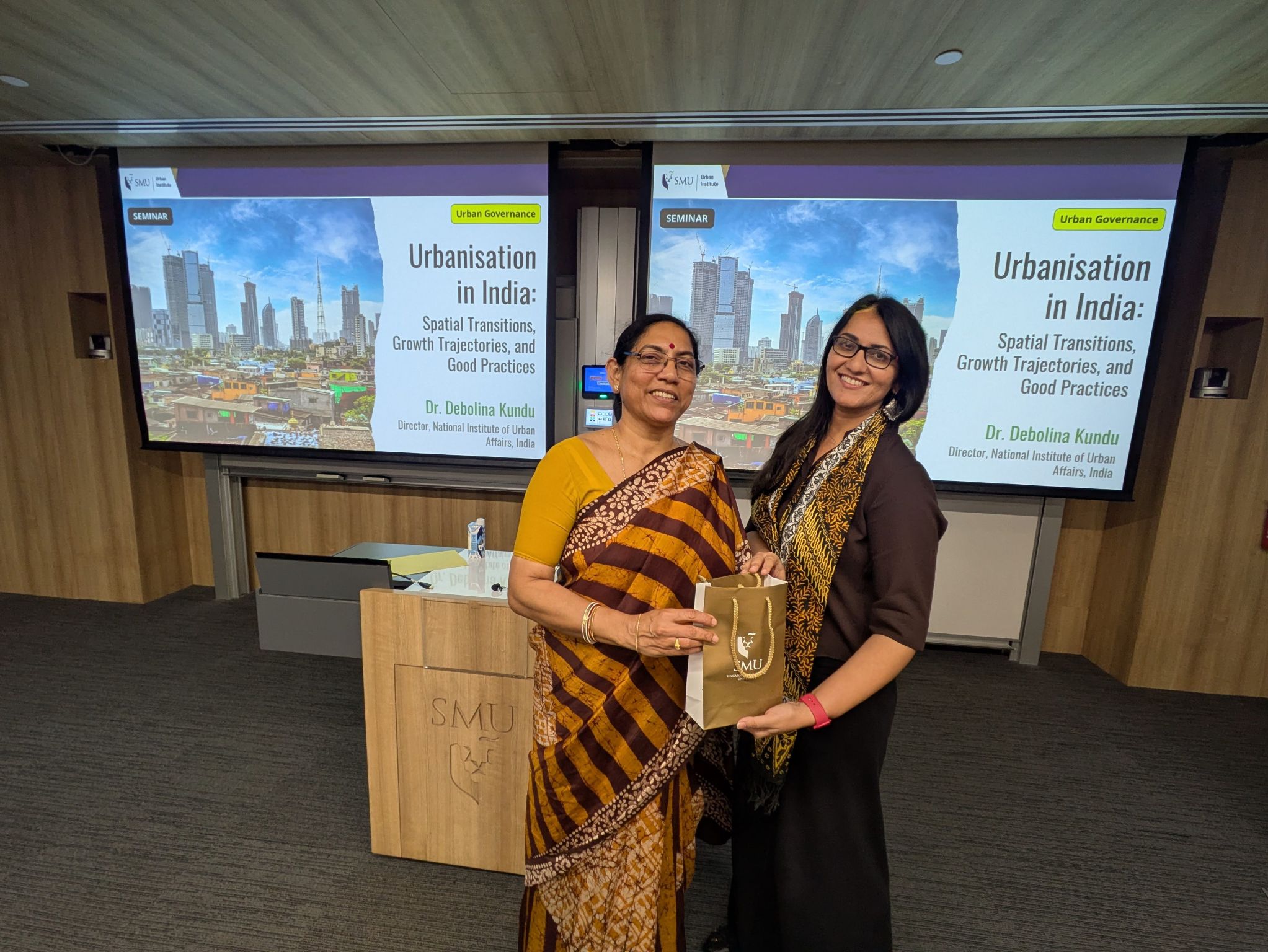
What does India's urban future look like? Dr Debolina Kundu, Director, National Institute of Urban Affairs (NIUA), presented a sweeping tour of India's urban landscape at last month's seminar under SgSMUUI's Urban Governance research pillar:
💠 The Global Context: By 2050, 70% of the world's population will live in urban areas, with 90% of urban growth occurring in Asia and Africa. India, China, and Nigeria are expected to account for one-third of global urban growth. Delhi is projected to become the world's largest city by 2035.
💠 India's Urban Reality — A Geospatial View: Officially, India is 36% urban. However, the DEGURBA methodology reveals that peri-urban areas are expanding faster than municipal boundaries. For example, Kerala's urbanisation rate increased from 26% to 48% through the emergence of 461 new census towns—settlements that are urban by definition but governed by rural administrations.
💠 Governance and Finance: Master plans exist for only 35% of towns, while government transfers to cities amount to just 0.5% of GDP, compared to 2–5% in many other developing countries.
💠 Islands of Good Practice: Despite persistent challenges, innovation continues to emerge. Examples include Odisha's Jaga Mission for in-situ slum redevelopment, MUKTA—a demand-driven urban employment programme—and the Kochi Water Metro in Kerala, which demonstrates the convergence of urban livelihood and public transport initiatives.
💠 New Policy Directions: The Urban Challenge Fund requires 50% private-sector participation, while cities are increasingly being reframed as economic regions rather than isolated administrative jurisdictions.
❔ Can India's peripheral growth be planned before it becomes chaotic, drawing lessons from Singapore's integrated regional approach?
❔ Which Indian cities are ready to "twin" with Singapore—for example, Surat for urban management or Indore for cleanliness and municipal innovation?
Grateful to everyone who joined the conversation, and to moderator Prof Ishani Mukherjee, Urban Fellow (Urban Governance), SMU Urban Institute. India is urbanising rapidly, and the time for collaborative learning is now.
For more information, please refer to the Linkedin post.