

Seminar: Hinterland Ecologies in the Anthropocene
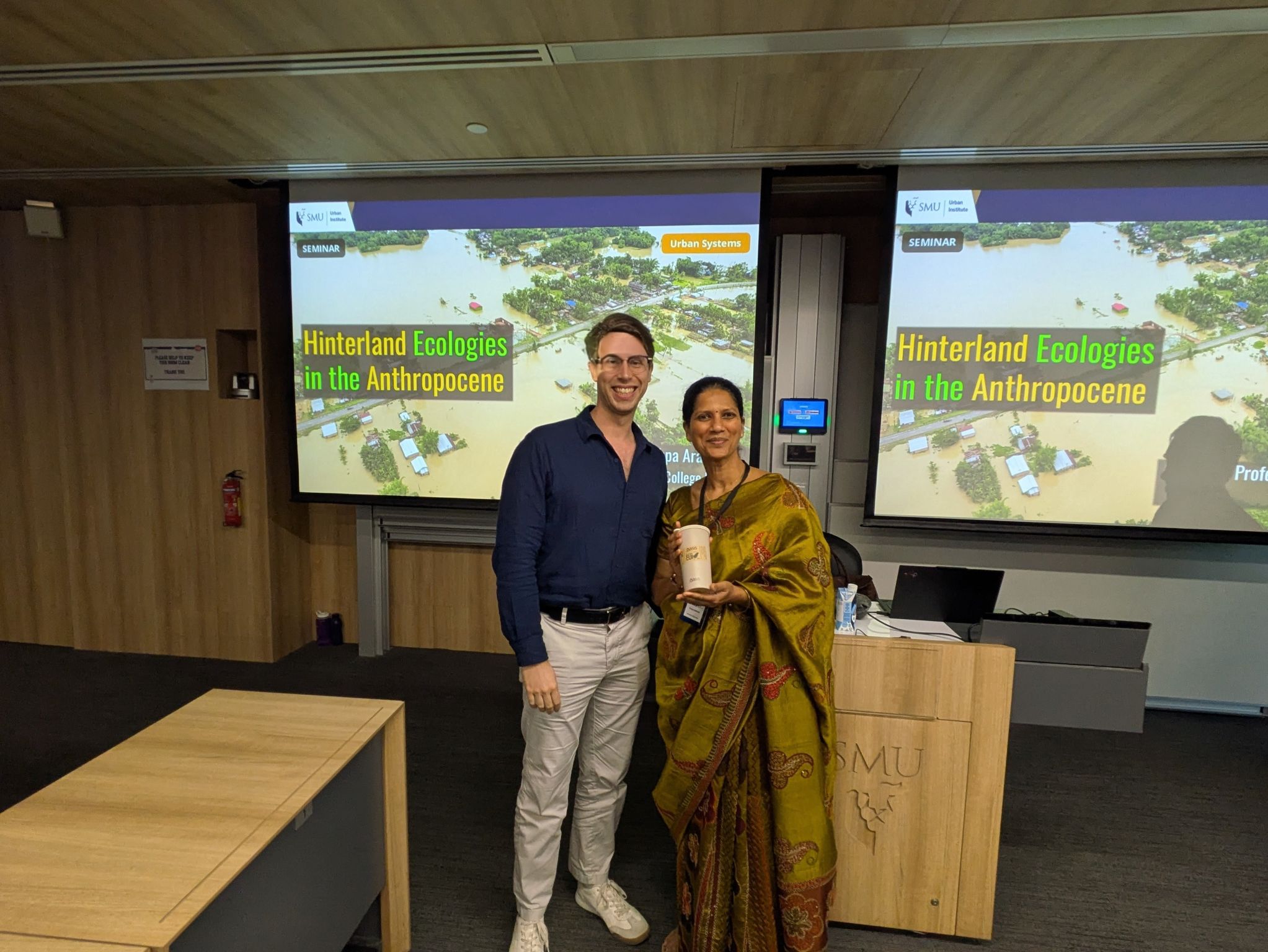
At our latest seminar, Prof Pushpa Arabindoo (UCL) reframed our understanding of urban planning, challenging us to look beyond metropolitan boundaries. In a session moderated by our Urban Fellow (Urban Experiences) Prof Jack Greatrex (SMU College of Integrative Studies), she presented a compelling case for integrating the ecological realities of the hinterland with the developmental ambitions of the city, using Chennai’s flood mitigation efforts as a case study.
🔍 Prof Arabindoo dismantled the notion of the city as a self-contained entity. She traced the 2015 Chennai floods not as an isolated "unprecedented" event, but as a symptom of a disconnect between urban development and its wider watershed. Through a rich discussion, the conversation crystallised around the following:
Planning Paradox: There is an appeal to modernist planning solutions like satellite towns and growth nodes, which might overlook the complex hydrological realities of the regions they occupy, especially when these "decongestion" efforts overlap with much-needed watersheds.
Drainage vs. Stagnation: The engineering impulse to "drain" water efficiently versus understanding natural "stagnation" as a fundamental part of an amphibious terrain. Can cities like Chennai and Singapore learn to live with inundation rather than fighting it?
The Call for More-Than-Human Planning: How can planners incorporate approaches that acknowledge multi-species needs—from mosquitoes to mangroves—into policy?
❔ As cities relentlessly expand, can we move towards a practice of planning ecologies that steers development in tandem with watershed realities?
❔ How do we retrofit not just buildings, but our imagination of the urban, to accommodate the uncertain and shifting terrain of land and water?
🔄 The call: Reclaim the hinterland as an ecological space and a critical lens. Prof Arabindoo urged planners and policymakers to see the hinterland not just as a space for extraction but as a co-constituted territory where the future of the city—its resilience, sustainability, and relationship with nature—is shaped.
A profound thanks to Prof Pushpa Arabindoo, Prof Jack Greatrex, and our engaged audience for a fascinating journey into the ecological frontiers of urbanisation.
For more information, please refer to the LinkedIn post.