

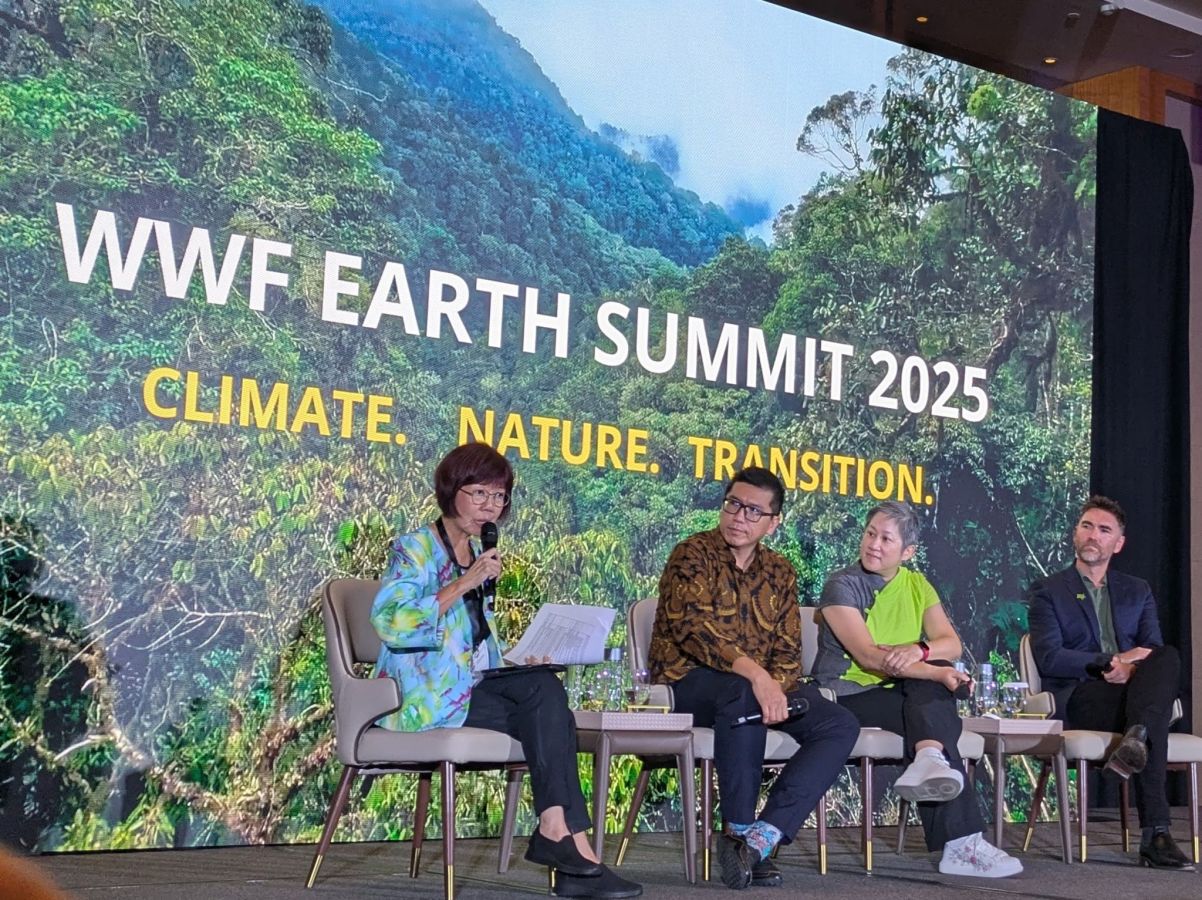
Singapore Management University was proud to be the only university represented on the speaker panel at the WWF Earth Summit 2025, held on Friday, 23 May. Themed "Climate. Nature. Transition," the summit brought together global leaders across sectors to examine how nature and finance can enable the transition to net zero while safeguarding ecosystems, livelihoods, and communities.
During the panel "How Can Nature-Based Solutions (NbS) Protect Climate, Biodiversity, and People?" expert emphasised the urgent need to scale up ecological strategies to combat climate change, biodiversity loss, and societal challenges. Prof Winston Chow, Co-Chair of the IPCC Working Group II and SMU Urban Institute (UI) Research Pillar Lead (Infrastructure), spoke about scaling up urban greening to deliver systemic cooling and biodiversity benefits. Key takeaways:
Think Big, Act Systemic: Large-scale green corridors (e.g., Singapore’s park connectors) are critical for cooling dense cities. Singapore’s success with urban greening e.g., parks, sky/rooftop gardens, and biodiversity corridors shows NbS works best at scale. He quoted studies from his Cooling Singapore 2.0 project to illustrate how large green networks are critical for heat mitigation in dense cities.
Data is critical: We need research to standardise NbS effectiveness metrics, and this isn’t just about Singapore. Cities globally need evidence to justify investments.
Collaborative Governance: Alignment across sectors (academia, government, communities) is essential to overcome challenges like funding gaps and fragmented efforts.
Tim Diamond (GM, Cotton On Foundation) shared how grassroots campaigns like tree-planting tied to retail sales of Cotton on Foundation products engage youth and consumers. Yu-Ning Hwang (CEO, National Parks Board) emphasised Singapore’s “Community in Nature” initiative, which mobilises volunteers for reforestation and species monitoring.
The session was expertly moderated by Prof Annie Koh, Professor Emeritus of Finance (Practice) from SMU Lee Kong Chian School of Business who urged policymakers to align courage with governance to turn aspiration into action.
Representatives from SMU UI, the SMU College of Integrative Studies's IPCC Working Group II and The SULTREE Lab also joined the summit as delegates, affirming SMU’s commitment to data-driven, climate-resilient urban solutions in Asia.
A big thank you to WWF-Singapore for the invitation and for spotlighting how science, finance, and community leadership can accelerate nature-positive transitions.